
DTCP vs CMDA for Industrial Projects in Tamil Nadu | Urban Liaison: What Every Investor Must Know Before Buying Land

Updated: Apr 1
If you are evaluating industrial land in Tamil Nadu — whether for a manufacturing unit, warehouse, logistics park, or EV facility — one question will define your entire regulatory journey: does your project fall under DTCP jurisdiction or CMDA jurisdiction?
Getting this wrong at the land selection stage is not a paperwork problem. It is a project-stopping problem. The approval authority determines which rules govern your layout, which clearances are mandatory, what land use permissions apply, and how long the approval process will realistically take in DTCP vs CMDA for Industrial Projects in Tamil Nadu | Urban Liaison
The Core Distinction: Jurisdiction, Not Just Rules
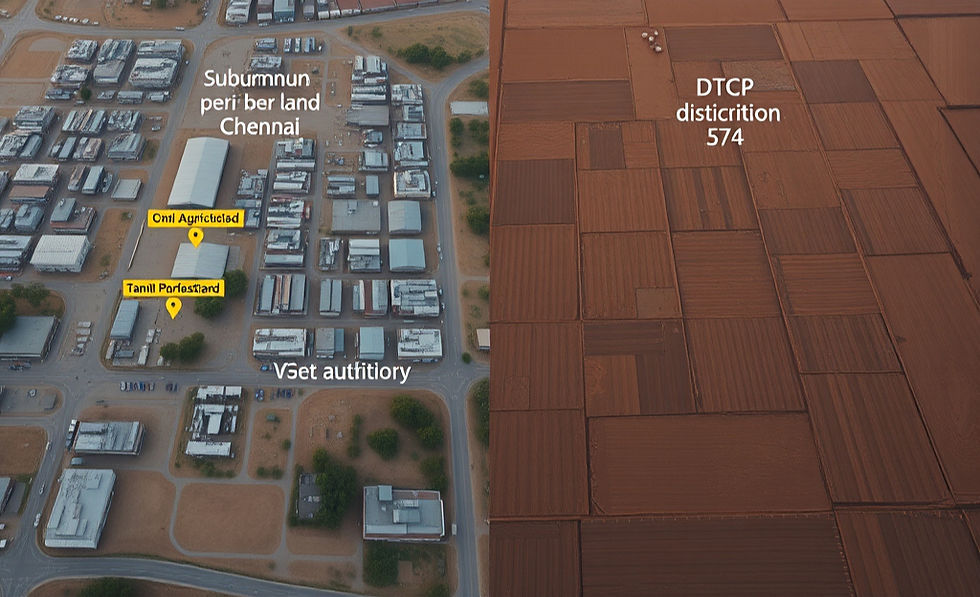
The Directorate of Town and Country Planning (DTCP) is a state-level authority operating under the Tamil Nadu Town and Country Planning Act, 1971. It governs land use, layout approvals, land use change (LUC), and building plan sanctions across all 38 districts of Tamil Nadu — excluding the Chennai Metropolitan Area.
The Chennai Metropolitan Development Authority (CMDA) is the planning authority for the Chennai Metropolitan Area (CMA), which covers Chennai District and designated portions of Thiruvallur and Kancheepuram districts. Any development within the CMA requires CMDA planning permission under Section 49 of the same 1971 Act.
The practical implication for industrial investors: your project's physical location determines which authority you are dealing with — not the type of project. An industrial facility in Sriperumbudur falls under DTCP. A warehouse in Oragadam, depending on the exact survey number, may fall under DTCP or CMDA depending on whether it sits within the extended CMA boundary.
Why the Boundary Question Is More Complex Than It Appears in DTCP vs CMDA for Industrial Projects in Tamil Nadu | Urban Liaison
Chennai's metropolitan boundary has expanded significantly over successive Master Plans. The CMDA Third Master Plan extended the CMA into areas previously under DTCP jurisdiction — including parts of Thiruvallur, Chengalpattu, and Kancheepuram. This creates a grey zone where a layout may have received DTCP approval for overall land subdivision, but individual building plan sanctions require CMDA clearance because the land now sits within the expanded CMA.
For industrial projects, this is not academic. A warehouse developer who secures DTCP layout approval for peri-urban land, proceeds with construction, and then receives a CMDA stop-work notice has lost time, capital, and credibility with project partners. The correct approach is to verify jurisdiction from both authorities before land acquisition, not after.
Approval Requirements: DTCP vs CMDA industrial projects Tamil Nadu
Under DTCP Jurisdiction
For an industrial project in a DTCP area, the typical approval sequence includes: Land Use Change (LUC) if the land is classified as agricultural or non-industrial; DTCP Layout Approval for multi-plot developments involving land subdivision; Building Plan Sanction from the relevant local body before construction; and DTCP Regularisation if any prior development was carried out without approval.
Under CMDA Jurisdiction
For projects within the Chennai Metropolitan Area, requirements are more stringent: Planning Permission under Section 49 is mandatory for every layout, subdivision, and land use change. Building Plan Sanction from CMDA is required before construction. CMDA Regularisation applies for structures built without sanction. Additional NOCs from Fire and Rescue Services and the Pollution Control Board may be required.
The Single Window Dimension
For industrial and manufacturing projects across Tamil Nadu — under either DTCP or CMDA jurisdiction — the Tamil Nadu Single Window Portal (TNSWP) is the mandatory platform for obtaining clearances from more than 30 government departments simultaneously. Errors in TNSWP project classification result in the wrong clearances being triggered, creating delays that are difficult to reverse without restarting the application.
What Industrial Investors Get Wrong
The most common mistake is treating the DTCP/CMDA question as something to resolve after land acquisition. The second is relying on the seller's representation of approval status. The third is not accounting for Land Use Change timelines — investors from Bangalore, Hyderabad, Mumbai, and Delhi frequently underestimate LUC approval timelines because the process is significantly different from land conversion in other states.
Before You Invest
Urban Liaison's CERTIFY pre-investment assessment delivers a complete DTCP and CMDA regulatory risk report for your specific land parcel within 72 hours, remotely. For investors evaluating Tamil Nadu industrial land from Bangalore, Hyderabad, Mumbai, Delhi, Pune, or Ahmedabad, CERTIFY provides the Go/No-Go regulatory analysis you need before capital is committed — not after.
![Land Use Change (LUC) in Tamil Nadu: Complete Guide for Industrial Investors [2026]](https://static.wixstatic.com/media/38f31d_15702db8ea144fb683c68a277874e1ba~mv2.jpg/v1/fill/w_980,h_980,al_c,q_85,usm_0.66_1.00_0.01,enc_avif,quality_auto/38f31d_15702db8ea144fb683c68a277874e1ba~mv2.jpg)
![DTCP Regularisation in Tamil Nadu: Eligibility, Process, Documents and Timeline [2026 Guide]](https://static.wixstatic.com/media/38f31d_95f597e7894947a9930ba19f6641c39e~mv2.jpg/v1/fill/w_980,h_980,al_c,q_85,usm_0.66_1.00_0.01,enc_avif,quality_auto/38f31d_95f597e7894947a9930ba19f6641c39e~mv2.jpg)

Comments